What Is Country Swing?
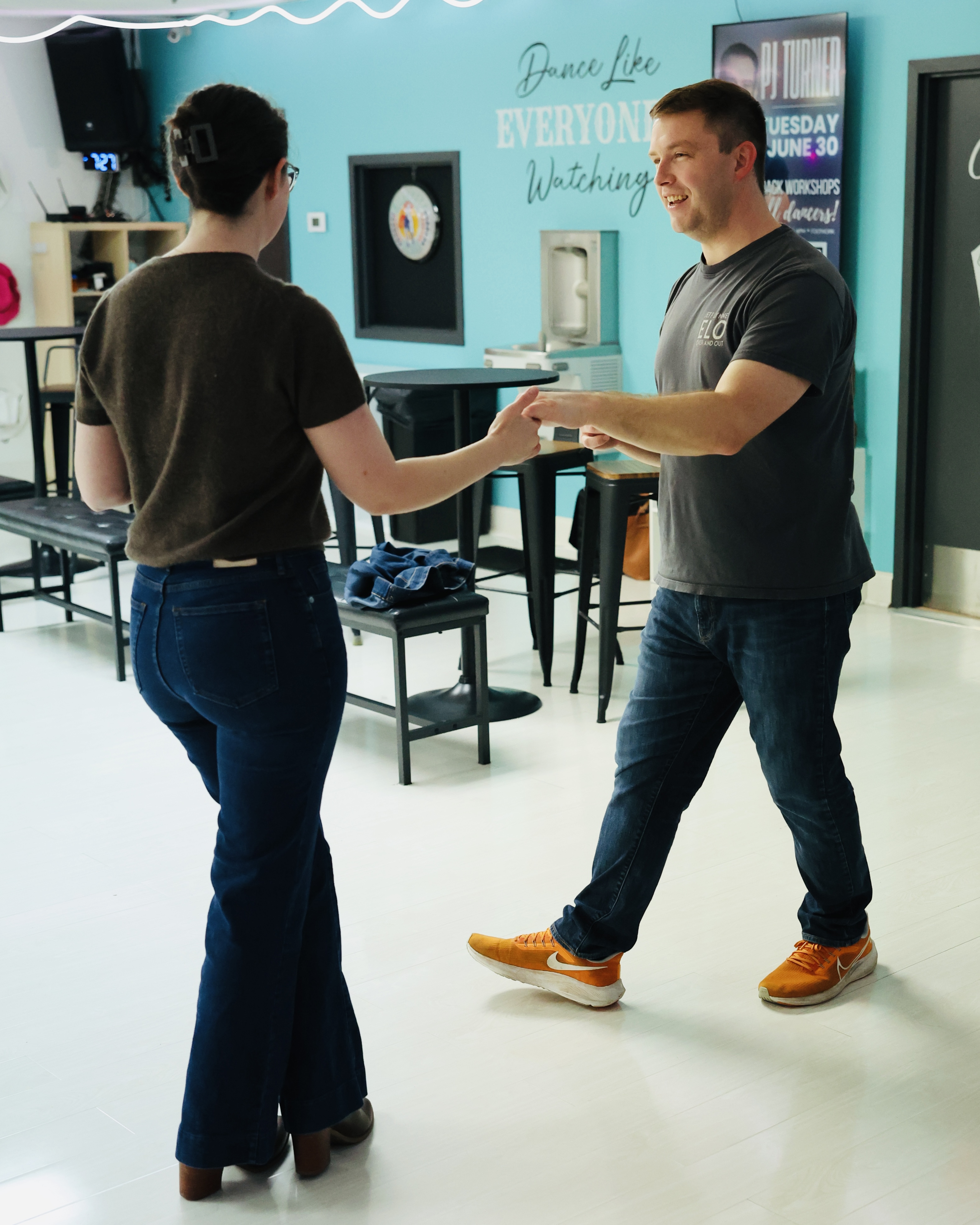
Country swing is a partner dance built around rhythm, connection, and two partners moving around one another. It usually stays in a fairly small area of the floor, with turns and changes of place that can be put together as you go.
That’s the short answer. The longer one gets interesting, because people who dance country swing don’t always agree on exactly what makes it country swing. How much should it rotate? Does it have one basic rhythm? If you’re borrowing from another dance, at what point does it stop being country swing?
Those are useful questions, even if all you want right now is to feel comfortable dancing to a song you like.
What makes country swing recognizable?
The Country Swing Dance Council gives us a place to start: a stationary, rotational partner dance, with a rock-step foundation and a connection that lets partners communicate.
“Stationary” describes where the dance happens. You’re generally working within an area, rather than making a continuous trip around the room. “Rotational” describes how you move together: moving around one another is part of the dance’s basic character.
Then there’s the music. The council describes more than one timing, including slow-slow-slow and quick-quick-slow, while keeping rhythm and partner connection central. It also allows patterns of different lengths. Its definition leaves room for variety without treating every movement as equally characteristic of the dance.
How does it move through the space?
Rotational is a useful word, but it can leave you picturing two people going around in a circle for an entire song. There’s more room to play than that.
David Saylors and Danya Svir describe circular basics as foundational. They describe the dance as being constructed of primarily right-side passes with a dual swing action.
Think of a passing line that keeps turning. The leader moves out of the way, and the follower moves into the space the leader has left. As the partners continue, the line of the next pass points in a new direction. The paths inside the dance can be more angular than the circular shape you see from the outside.
The overall shape
From the outside, the partners appear to move around one another within a circle.
The path within it
The leader moves on; the follower fills the space the leader has left.
Why is the definition still up for debate?
There’s a difference between knowing a dance when you see it and agreeing on a definition that covers every version of it.
Glenn Ball explores that tension in There’s No Such Thing As Country Swing. His objection isn’t simply that dancers use different timings. In the show’s studio experiment, he says country swing doesn’t have to have one fixed timing. After trying several rhythms, he favors single-time for its versatility and ease of entry.
But flexibility and an absence of structure are different things. Glenn questions whether doing whatever you like to country music makes a distinct dance form. If that freedom is the goal, he suggests a name such as country freestyle or country fusion.
In his 2024 conversation with Glenn, Juan Aguirre of Juanna Dance describes country swing as a slotted dance that rotates its slot, built around rock-and-go movement. In his approach, partners first create stretch, then use that momentum to travel.
Robert Royston offers a different preference in his own 2024 episode: pass on the quick-quick, then settle and redirect on the slow, rather than use a rock step for the redirection. He accepts multiple rhythms as long as the dancing stays connected to the music. He is also comfortable with regional versions and giving the dance time to develop.
For us, the useful question is how much the dance can change while still being recognizable. If you borrow a turn, does that change the dance? Probably not by itself. If you change the timing, the connection, and the way the couple moves through the floor, at what point does it become a different dance entirely?
Why does any of this matter? A competition organization needs standards to judge by and definitions judges can apply consistently. Instructors need a coherent framework they can give their students, so one lesson builds on the next. Social dancers need enough common ground to dance comfortably with one another—even when they learned from different people. A definition earns its keep when it helps with those things.
How is it different from two-step and West Coast Swing?
One of the easiest differences to see is the way each dance uses the floor. Two-step travels around the outside of the room. West Coast Swing organizes its patterns along a slot. Country swing generally rotates within a smaller area.
Two-step
Progressive: the couple travels along the floor and curves around the corners.
West Coast Swing
Slotted: both partners work along a shared line.
Country swing
Rotational: the passing line changes direction as the partners move around one another.
These shapes are a starting point for recognizing the dances, not the whole story. Timing and connection matter too. A familiar turn can appear in more than one style; how you enter it, move through it, and continue afterward helps give it the character of that dance. Our country swing versus two-step guide goes further into choosing between those two.
What should you learn first?
Ask your instructor about the timing and the shape of the dance they teach. Have them show you how those ideas work with the music and with a partner. You’re looking for an approach you can understand, practice, and use where you live.
You don’t need everyone to agree on a final definition before you start dancing. You do need a foundation that helps you move with the person in front of you.
Having a clear framework to study may matter more than choosing the one you’ll agree with forever. Whether you start from the Country Swing Dance Council’s description, David and Danya’s approach, Juan’s, or what we teach at Turn Their Heads, give yourself some solid ground to work from. Learn an approach well enough to understand what it does. You can compare it with others—and change your mind—as your dancing grows.
If you’re in Nashville and want to learn, Turn Their Heads offers country swing lessons for individuals and couples. You can also find instructional videos on the Turn Their Heads YouTube channel.